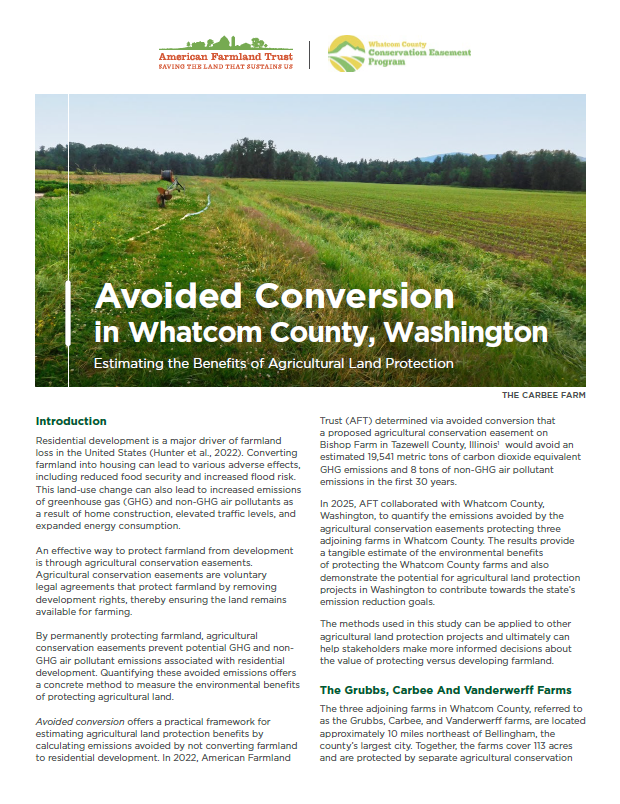

Agricultural conservation easements permanently protect farmland from development, providing benefits for agriculture, communities, and the environment. This case study examines three adjoining farms totaling 113 acres in Whatcom County, Washington, and estimates the greenhouse gas (GHG) and air pollutant emissions avoided by protecting the land from residential development. Using an adapted California Air Resources Board methodology and Washington-specific data, American Farmland Trust estimates that the easements will avoid approximately 3,755.64 tons of GHG emissions and 2.44 tons of non-GHG air pollutant emissions between 2023 and 2050. These emission saving benefits result from reduced vehicle travel, energy use, and soil carbon loss that could otherwise occur with residential development. The study demonstrates how avoided conversion can help quantify the environmental benefits of farmland protection and illustrates the potential contribution of agricultural conservation easements toward Washington State’s emission-reduction goals.